
Tunde Odesola
In Nigeria’s bustling cyberspace, Albert Ofosu Nketia is a name that needs an introduction, but his face doesn’t. At barely seven, Nketia’s meme is potentially the most popular kid video in the Nigerian social media space. The fluky kid holds a permanent residency in the phones of millions of Nigerians who carry him about rent-free without knowing his name or nationality. You probably have seen him crying and laughing altogether on your phone today.
Nketia is that little boy in a faded, black-and-white checkered shirt worn over torn blue jeans, sitting at the doorstep of an old house. In the now-famous video lasting less than 10 seconds, the child begins in tears, his face scrunched in misery, but his crying suddenly changes into a burst of laughter, revealing two missing upper teeth. Even Sorrow, the father of Sadness, would fold up in laughter if it witnessed Nketia’s melodramatic switch from tears to tickle.
But there is a short story behind Nketia’s hilarious video. This is the story.
It was dinner time in a poor Ghanaian home in the year 2023. Nketia had looked forward to a meal of yams and stew, but the mother hung her son’s hunger on the scale of availability by cooking plantain instead. Frustrated, Nketia launched into tears, quickly, his grandmother, whom the video did not capture, sang him a song, and he burst into laughter in the same breath.
Nketia’s uncle recorded the bittersweet incident with his phone. He sold his phone shortly afterwards, without deleting the video. The new owner saw the video and posted it online. The internet went afire.
From the pangs of hunger to the melody of grandma’s lullaby, Nketia’s seriocomic turns full circle. His performance quietly interrogates the maxim “a hungry man is an angry man,” while also asterisking the Yoruba proverb, “ebi kìí wọnú, kí ọ̀rọ̀ mí wọ̀ ọ́.” Yet, Nketia’s cry-laugh paradox also illustrates the theme of clarity in the Yoruba proverb that says, ‘ti a ba n sunkun, a ma n riran’ – tears do not blur the eyes from seeing.
A few days ago, Nigeria witnessed its own cry-laugh theatre.
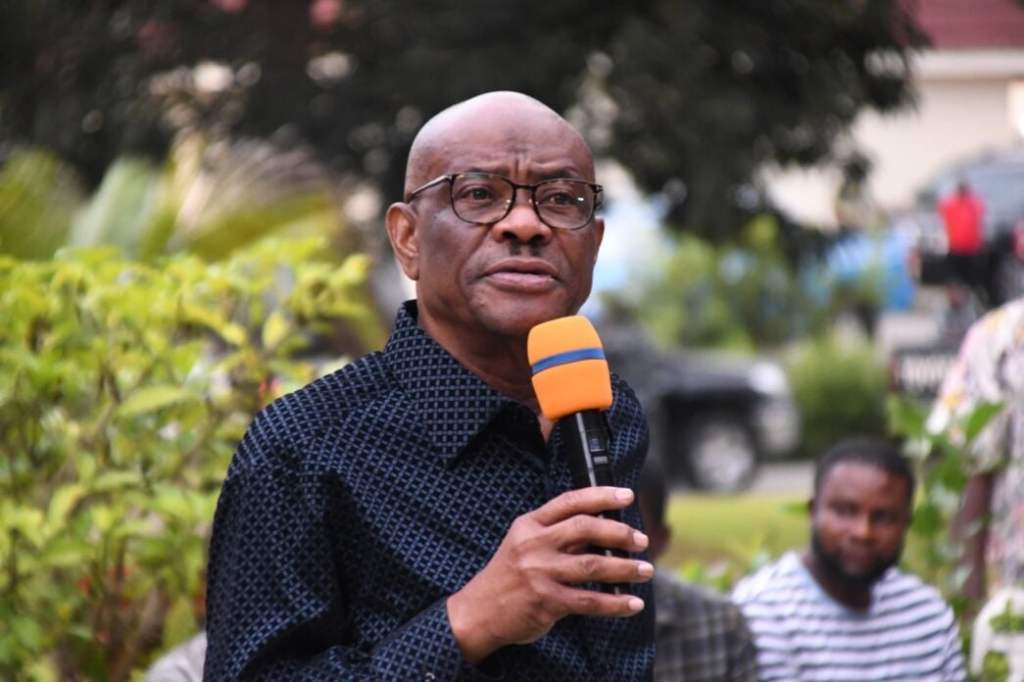
The almighty Minister of the Federal Capital Territory, Chief Nyesom Wike, made a U-turn from the trajectory of tragedy into the corridor of literature when the bushrat he thought he had caught by the tail, wriggled out of his grip, leaving in his fist white tail hair, ‘òkété bórù mọ́ Wíke lọ́wọ́’.
Known for his volcanic temper and intimidating rhetoric, Wike, the talkative minister, expressed anger about the comments made by television anchor Seun Okinbaloye, who warned on live television that the nation was heading towards a one-party state, with the systematised electoral impediments allegedly strewn in the path of the African Democratic Congress.
Okinbaloye wailed on Channels TV programme, Politics Today, “What makes the race very interesting is when it is competitive. I mean, not when only one party stands in the middle of the ballot, and you’re looking for the rest of the political parties. I mean, when some of us talk, it looks like our mouths are smelling. Yeah, we’ve been on this ground for a while, and you thought there were a lot of experienced men in the ADC; they should have seen the devil in some of the issues that have been raised over the past month. But we get one of them talking tonight about the fate of the ADC. Particularly, it looks like one of the only hopes of the opposition, going into 2027. If this hope is dashed, we are doomed democratically speaking.”
The remarks stung Wike like pepper in the eye, and he yelled. So, in a rebuttal to the TV anchor’s lamentation, a guttural Wike addressed a press conference in Abuja, Nigeria’s seat of power, and erupted, “In fact, I was surprised yesterday, thoroughly surprised when I was watching ‘Politics Today’, Seun. If there was any way to broke (sic) the screen, I would have shot him.”
One of the journalists at the press conference quickly interjected, asking, “And commit murder?” while another asked if Wike was only going to shoot the TV screen or shoot the anchor himself. Wike replied chillingly, “In fact, it (the shot) would get to him (the anchor).”
To Wike, the lawyer and self-proclaimed democrat, Okinbaloye’s offence was so grave that only being shot was fitting enough for punishment, not a day in court, not an allocution, not a fine, not time in jail; only the trigger would do. The gun is mightier than the pen. Blood is sweeter than truth.
Nyesom, the son of Wike, goes on to further aver that, as the interviewer, it was wrong of Okinbaloye to immerse himself in the conversation by saying, “We cannot allow only one party…,” stressing that with such a statement, the anchor had left the Fifth Estate of the Realm and descended into the pit of politics.
Therefore, Wike, a former council chairman, former governor, former minister, leader, father and Christian, was so livid that he brought a double-barreled to the press conference. Through one barrel, he fired hyperbolic shots. Through the other barrel, he fired grammatical blunders that made viewers wonder if the minister’s middle name was Oníbọnòjé or if he ever went on hunting expeditions in the forest of a thousand demons. Only Chief Zebrudaya, alias 4:30 of the rested New Masquerade sitcom and popular content creator, Legge Miami, could say, “If there was any way to BROKE the screen…,” like Wike confidently did.
Although Wike explained that his fury against Okinbaloye’s position incensed him enough to point a figurative gun at his TV screen and blow the anchor’s nutty head off, the backlash that trailed his cock-and-shoot outburst necessitated a further clarification by his media team. In the clarification, the minister explained that his gun-blazing cowboy bravado was only a hyperbole, and not ‘talk and do’. Exaggeration is a more popular word for hyperbole. Wike’s use of exaggeration is not lost on Nigerians, who are used to exaggerated electoral promises and achievements by the political class.
But there is more to Wike’s purported hyperbole than meets the eye. Parentally speaking, if Wike’s former political benefactor, now archenemy, Chief Rotimi Amaechi, says he was going to hyperbolically shoot Jordan, Wike’s son, would Wike have dismissed such a threat or would he not call press conferences across the seven continents of the world, begging President Donald Trump to come to his rescue? How does Wike think Okinbaloye’s wife, children and relatives would feel when they hear a powerful government official threaten their loved one? Wike owes Okinbaloye, Channels and Nigerians a public apology for his indiscretion. He should not turn a crying matter into laughter like Nketia, the little Ghanaian kid. He shouldn’t hide a death threat behind the olive branch of hyperbole.
Wike’s leaky outburst has an ethical dimension that speaks to the unholy imbalance between power and press freedom in Nigeria’s democracy. When a former governor, federal minister and kitchen cabinet member in the Presidency says he would shoot a journalist, even rhetorically, it creates what scholars like Michel Foucault, Pierre Bourdieu, and Max Weber call “structural intimidation.” Structural intimidation does not rely on direct threats, but instead uses power, authority, systems, or institutional position of a person or organisation to create fear, pressure, or silence in others. It is intimidation built into the structure of power. Like the invisible breeze rustling the fronds of beach palms, victims of structural intimidation sense the storm long before the branches break. To date, the death by parcel bomb of Dele Giwa, editor-in-chief of Newswatch magazine, remains a mystery. Many Nigerians believe say na Baba kill Dele Giwa.
The spinoff of Wike’s rage is that such rhetoric is capable of normalising violence against journalists, media houses, and undermining press freedom. Back in the day, as a reporter, I was declared persona non grata by top government functionaries and the police. Shortly after leaving office, a top government official disclosed to me that there was a consideration to eliminate me during their administration. It thus goes to say that if Okinbaloye shows up in Port Harcourt in the heat of this back and forth, some overzealous Wike supporters, who worship him like a cult hero, might feel moved to exact a pound of flesh from the journalist, in the belief that the enemy of our oga is our enemy.
Without holding a physical gun in his hands, Wike’s outburst kills three birds. One: It delegitimises Channels TV and Okinbaloye, framing both as having crossed the boundary. Two: It asserts power and the capacity to inflict harm. Three: It arrogantly places Wike above the law, untouchable, all-powerful, unlimited, fearsome, tough, rough and uncouth.
Wisdom warns that power without control is dangerous. A gun in the hands of an idiot is a disaster in waiting. The hullabaloo over the gun in Wike’s hand is not because he is a great marksman. It is because of his office and his closeness to Aso Rock. If I analysed Okinbaloye’s comments, as Wike did, and I wrote in my column, “I would have broken the TV screen and shot him,” nobody would have raised an eyebrow; people would understand it as an exaggeration. Why? Because I’m not in a position to mobilise such a whim into reality. But when a powerful government official says something similar, it acquires institutional weight, and the statement begins to sound like state intimidation, even if unintended.
In this point-and-kill saga, Wike deserves pity because he was felled by his temper, like King Odewale in Ola Rotimi’s ‘The Gods Are Not to Blame’. In the fury of his temper and uncontrollable tongue, Wike arrogantly plucked his own eyes, abandoned the pathway, and headed into the bush. Wike is a lawyer and a politician. He is not a journalist. Interestingly, Nyesom is informed enough to know that journalism demands neutrality. He knows one of the two competing models of journalism, which is Objective Journalism. Objective Journalism expounds neutrality, without personal opinion. But this is where Wike’s education about journalism stopped. He does not know about Interpretative/Narrative/Sensationalist Journalism, where the journalist analyses and interprets news. Interpretative/Narrative/Sensationalist Journalism dwells more on a narrative, analytical, dramatic or sensational approach to news to excite and engage readers emotionally.
Therefore, if Wike did not suffer from half a journalism education, he would have known Okinbaloye was rightly doing his job. This is not to deny the fact that I am an advocate of Objective Journalism, like Wike, but I won’t shoot Okinbaloye if he decides to wail on TV like a man pursued by unseen spirits. Both journalism models have their intrinsic values.
In Nigeria, words are eggs that drop and break. The yolk is packed back into the smithereens shells, that is why our life is like what it is, unproductive, stagnant and smelly. Nobody accounts for anything – public funds, promises, and words.
If Nigeria were not governed by rickety leadership, the Nigerian Broadcasting Commission would have been free to demand a public apology from Wike, issuing him a stern warning because his language is capable of inciting hostility toward an individual and organisation. But the NBC had gone mute since the Wike earthquake shook Nigeria’s media space.
During the 2012 election campaign, US presidential surrogate Ted Nugent said that if Barack Obama were re-elected, he would either be “dead or in jail by this time next year.” The comment was seen as a veiled threat against the President. Nugent was investigated by the U.S. Secret Service and quickly removed from his role as a prominent surrogate for Mitt Romney’s campaign. That will never happen in Nigeria.
In Australia, Robert Oakeshott, a Member of Parliament, in 2014, used language interpreted as threatening political opponents and implying retaliation. He subsequently lost political standing and withdrew from federal politics. Another Australian Member of Parliament, Peter Dowling, sent threatening messages to a political opponent, warning him about consequences during a campaign dispute. Public outrage forced him to resign his parliamentary seat in 2012.
In 2019, a Canadian Member of Parliament, Mike Hill, joked during a parliamentary justice committee meeting about “stoning” women who had abortions. The comment triggered national outrage and condemnation across political parties. He was expelled from his party caucus and later lost his political career. In sane climes, even hyperbolic references to violence can end political careers.
Carlo Paladino, US Congressman, said during a political rant in 2023 that he hoped then-US Attorney General Merrick Garland would “die in prison”. The House Ethics Committee opened an investigation, and Paladino lost political support, effectively ending his congressional career.
In a country where political power is seen as a commodity to be ‘snatched, grabbed and run away with it’, where foreign election monitors were threatened in Kaduna to be returned to their countries in body bags, Wike’s outburst is another punch below the belt. It’s about time Nigerians held their leaders accountable for their words and guns.
Email: tundeodes2003@yahoo.com
Facebook: @Tunde Odesola
X: @Tunde_Odesola
 Extrasportnigeria
Leave a comment